South America Newsletter April 2026
This month we bring you news from Argentina, Brazil, Chile, Colombia, Ecuador, Peru, and Venezuela, as well as one story impacting across the region.
Highlights are:
- Across the region, in a new report, Tearing Up The Social Fabric, Amnesty has documented how State authorities in the Americas have promoted and enacted a growing number of laws that restrict or control civil society organisations
- In Argentina, on the 50th anniversary of the 1976 military coup, tens of thousands marched in Buenos Aires and across the country to honour victims of the dictatorship.
- International Women’s Day marches in Brazil served as a rallying cry against gender-based violence, fuelled by the latest case to outrage the country involving the alleged gang rape of a 17-year-old girl in Copacabana.
- For Chile, there is a new Urgent Action, calling for the new president to ensure accountability for all serious human rights violations and crimes under international law and to refrain from pardoning convicted former Carabinero and military officials.
- Human rights defenders in Colombia have been subjected to unrelenting violence over the past decade, with on average just under 100 killed every year, a report issued by the UN Human Rights Office finds.
- For Ecuador, the United Nations Committee on Enforced Disappearances assessed the progress and challenges faced by Ecuador in preventing, investigating and punishing enforced disappearances. Amnesty submitted informationto the Committee.
- The Inter-American Court of Human Rights has condemned Peru over the death of its citizen Celia Ramos, who died at the age of 34 in 1997 after undergoing sterilisation “under coercion”.
REGIONAL
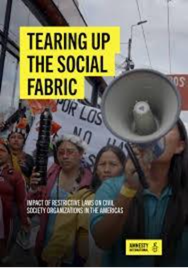 In a new report, Tearing Up The Social Fabric, Amnesty has documented how State authorities in the Americas have promoted and enacted a growing number of laws that restrict or control civil society organisations, reinforcing authoritarian practices that threaten freedom of association and curtail civic space. The report documents how new laws in Ecuador, El Salvador, Nicaragua, Paraguay, Peru and Venezuela are leading to self-censorship, weakened citizen participation and oversight, and erosion of the social fabric as trust and community networks break down, while victims of human rights violations are left unprotected.
ARGENTINA
On March 24, the 50th anniversary of the 1976 military coup, tens of thousands marched in Buenos Aires and across the country to honour victims of the dictatorship, while human rights groups and international experts warned of setbacks in ongoing efforts to secure truth and justice. Human rights organisations estimate that 30,000 people were disappeared during the dictatorship. At least 500 newborn babies were also stolen from prisoners and given to military families to raise, with some unaware to this day of their true identity.
United Nations human rights experts expressed deep concern over recent regressive measures taken in Argentina that threaten to undermine four decades of exemplary progress in memory, truth and justice. A proposed pardon for military personnel convicted of international crimes would represent a serious setback for accountability. Also highlighted are the reduction of the State’s role in promoting criminal investigations for crimes against humanity, the obstruction of access to the dictatorship’s archives, and the weakening of mechanisms for reparation and support for victims.
BRAZIL
International Women’s Day marches in Brazil served as a rallying cry against gender-based violence, fuelled by the latest case to outrage the country involving the alleged gang rape of a 17-year-old girl in Copacabana. The case has added fuel to the fire in a nation where reports of violence against women continue to climb, with 1,568 reported femicides in 2025 alone, a 4.7% increase from the previous year and more than three times the number in 2015, according to the Brazilian Forum on Public Safety. To read more, click here.
CHILE
There is a new Urgent Action. On taking office, President José Antonio Kast (dgcp@presidencia.cl) stated that he may pardon former Carabineros and military officials convicted of crimes committed during the 2019 protests. This would further entrench impunity. Amnesty International urges the new president to ensure accountability for all serious human rights violations and crimes under international law and to refrain from pardoning convicted former Carabinero and military officials. Please copy in the Ambassador to the UK, Embassy of Chile, 37-41 Old Queen Street, London SW1H 9JA
Amnesty International Chile called on the incoming president and his administration to fulfil their human rights obligations in all their policies and government proposals. They also called on all members of the new National Congress to legislate with human rights as their guiding principle and to maintain consistency with the international human rights standards to which Chile has committed.
International Women’s Day was celebrated with marches in 20 cities across Chile, with half a million people taking to the streets of Santiago. But there were also many protests against the incoming government. Throughout his three-decade career in politics, Kast has consistently blocked progressive efforts to advance women’s rights and equality, and voted against the legalisation of divorce. He is against access to free abortion, and he’s stated that he intends to roll back progress on sexual and reproductive rights.
COLOMBIA
Human rights defenders in Colombia have been subjected to unrelenting violence over the past decade, with on average just under 100 killed every year, a report issued by the UN Human Rights Office finds. The report provides a detailed account of events between 1 January 2022 and 31 December 2025, when 410 human rights defenders were killed. In all, 23 percent of the victims were Indigenous Peoples, an extraordinarily high percentage considering that the Indigenous population represents only 4.7 percent of the country’s total population. To read more, click here.
ECUADOR
During its session in Geneva on 10 to 12 March, the United Nations Committee on Enforced Disappearances assessed the progress and challenges faced by Ecuador in preventing, investigating and punishing enforced disappearances. Amnesty submitted information to the Committee based on its report “It was the military, I saw them: Enforced disappearances in Ecuador at the hands of the armed forces”, which documented the disappearance of ten people in five security operations carried out in 2024. Amnesty has stated that these crimes remain unpunished and will continue to happen as long as President Noboa’s security policy remains militarised.
Human Rights Watch has accused Ecuador of failing to comply with key provisions of an Inter-American Court of Human Rights ruling to protect the Tagaeri and Taromenane Indigenous peoples. The groups live in voluntary isolation near oil facilities inside Yasuní National Park. In March 2025, the court ordered Ecuador to take measures to protect the Indigenous groups, including by immediately stopping oil operations in an area of Yasuní National Park called Block 43. Despite a court-ordered deadline of March 2026 to improve protective measures and monitoring, the government has produced few results.
Following an observation visit to Ecuador in March, a group of international Human Rights organisations, including Human Rights Defenders, expressed grave concern about the “situation of repression and human rights violations, particularly against human rights defenders as well as Indigenous Peoples and Nationalities, campesino and Afro-descendant communities, women and young people, and civil society organisations that make up the social fabric of Ecuador”.
PERU
The Inter-American Court of Human Rights has condemned Peru over the death of its citizen Celia Ramos, who died at the age of 34 in 1997 after undergoing sterilisation “under coercion”. The landmark ruling is the first on Peru’s forced sterilisation programme, which operated between 1996 and 2000 and was directed against poor, rural and Indigenous women. The court held the Peruvian state “internationally responsible” for the violation of Ramos’s right to life, health, personal integrity, family, access to information and equality before the law.
VENEZUELA
Reports allege that detainees have continued to be tortured in Venezuela, with the United Nations’ High Commissioner for Human Rights, Volker Turk, calling such reports concerning. Turk has welcomed the new Amnesty Bill, recently passed into law, which was promised to allow for the release of political prisoners, but has noted that “structural and systematic human rights concerns have persisted”. Human Rights group Foro Penal has only been able to confirm the release of fewer than 700 detainees so far.
OUR TEAM AND YOU
All the best,
South America Team – Carolina Beresford (Brazil and Colombia) David Rogers (Argentina and Chile), James Baird (Venezuela) and Graham Minter (rest of South America,). And please don’t forget that you can follow us on our Facebook page and Twitter.
Follow me!